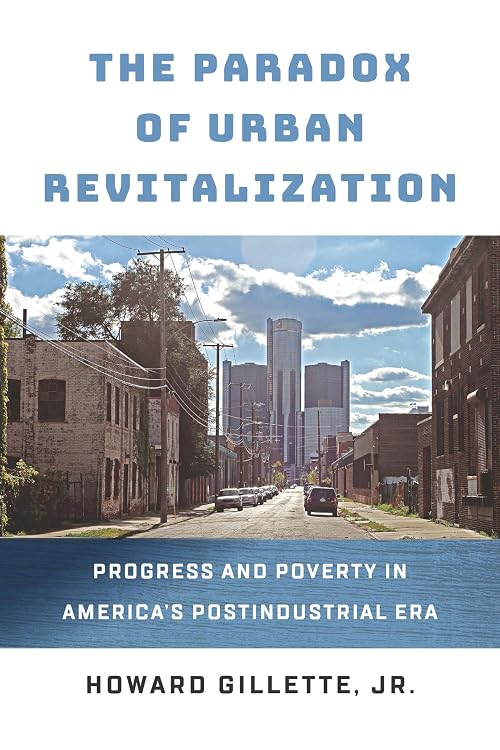
The Paradox of Urban Revitalization: Progress and Poverty in America's Postindustrial Era
Progress Poverty America's: The Paradox of Urban Revitalization examines how renewed investment in U.S. postindustrial cities has coincided with inequality and social unrest. Howard Gillette, Jr. profiles nine cities and considers the tension between corporate subsidies and efforts to advance racial and class equity.
At a glance
- Profiles nine U.S. cities facing the consequences of postindustrial economic change.
- Examines urban revitalization alongside inequality and civil unrest.
- Discusses racially biased investment, affordable housing constraints and mass incarceration.
- Traces urban policy and politics over roughly half a century, with discussion of prospects for greater equity.
Reference price: $45.00
Price checked: Nov 27, 2026
View offerBlack Friday weekExplore the selectionPros and cons
Pros
- Nine-city coverage offers a comparative view of urban change rather than focusing on one city.
- Connects investment and revitalization policy with racial and class equity concerns.
Technical specifications
8 specifications| Publisher | University of Pennsylvania Press |
|---|---|
| Publication date | June 7, 2022 |
| Language | English |
| Print length | 344 pages |
| ISBN-10 | 081225371X |
| ISBN-13 | 978-0812253719 |
| Dimensions | 6 x 1.4 x 9 inches |
|---|---|
| Weight listed | 1.55 pounds |
What to know before buying
- The book's account considers events and policy before the COVID-19 pandemic, so it does not cover pandemic-era developments in its analysis.
Who is it for?
A good fit for
- Readers studying U.S. urban policy, city planning and postindustrial change.
- Students and researchers interested in housing affordability, racial equity and urban inequality.
- Readers seeking analysis across multiple U.S. cities rather than a single-city case study.
Less suited to
- Readers seeking coverage centered on the COVID-19 pandemic or later urban developments.
- Readers looking for a practical step-by-step city planning manual.
Frequently asked questions
What is this book about?
It examines the uneven effects of urban revitalization in postindustrial U.S. cities, including inequality, housing affordability, racial equity and city policy.
How many cities does the book profile?
The supplied description says the book profiles nine cities.
Does the book cover the COVID-19 pandemic?
Its account of urban politics and policy is described as covering the period before the pandemic, so it is not presented as a study of pandemic-era developments.
Alternative options
Beyond Steel: Pittsburgh and the Economics of Transformation
$15.58
The Next American Metropolis: Ecololgy, Community, and the American Dream
$50.58
Broken City: Land Speculation, Inequality, and Urban Crisis
$25.38
The Divided City: Poverty and Prosperity in Urban America
$21.86
Communities of Resistance and Resilience in the Post-Industrial City (Routledge Studies in Modern History)
$64.99
Places in Need: The Changing Geography of Poverty
$30.87
Master Plans and Encroachments: The Architecture of Informality in Islamabad (The City in the Twenty-First Century)
$79.07
China Urbanizing: Impacts and Transitions (The City in the Twenty-First Century)
$73.00
Nation's Metropolis: The Economy, Politics, and Development of the Washington Region (The City in the Twenty-First Century)
$67.72
Equality and the City: Urban Innovations for All Citizens (The City in the Twenty-First Century)
$35.10
Underground: Dreams and Degradations in Bucharest (The City in the Twenty-First Century)
$115.47
Urban Planning in a World of Informal Politics (The City in the Twenty-First Century)
$67.41