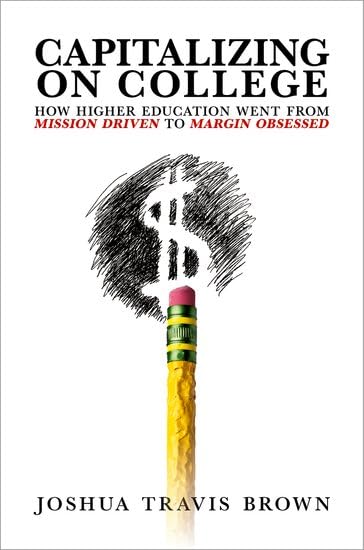
Capitalizing on College: How Higher Education Went from Mission Driven to Margin Obsessed
Higher Education Went Margin Obsessed: Capitalizing on College examines how tuition-dependent colleges shifted toward market-driven financial strategies and the consequences for their institutional missions. Joshua Brown draws on interviews with university leaders to trace approaches to revenue growth and the pressures they created.
At a glance
- Explores how tuition-driven colleges respond to financial pressure and demographic shifts.
- Discusses three revenue strategies that fell short of sustaining residential campuses and a fourth, scaling up, that raised funds while putting institutional mission under pressure.
- The account is based on interviews with more than 150 university leaders, according to the listing.
Reference price: $99.00
Price checked: Nov 25, 2026
View offerBlack Friday weekExplore the selectionPros and cons
Pros
- Connects institutional finance strategies with their implications for access, opportunity, and college mission.
- Uses interviews with university leaders to present an inside view of higher education’s market pressures.
Technical specifications
8 specifications| Publisher | Oxford University Press |
|---|---|
| Publication date | April 9, 2025 |
| Language | English |
| Print length | 320 pages |
| ISBN-10 | 0197780709 |
|---|---|
| ISBN-13 | 978-0197780701 |
| Weight listed | 1.21 pounds |
|---|---|
| Dimensions | 6.13 x 0.86 x 9.25 inches |
Who is it for?
A good fit for
- Readers interested in higher education finance, institutional strategy, and college leadership.
- Students and researchers studying how market competition affects colleges and their missions.
Less suited to
- Readers seeking a practical guide to choosing a college or personal college-financing advice.
Customer reviews on Amazon
- 5 stars
85% 85% - 4 stars
9% 9% - 3 stars
0% 0% - 2 stars
0% 0% - 1 star
6% 6%
Customer feedback describes the book as insightful, meticulously researched, analytically rigorous, and readable, with particular appreciation for its interviews with university leaders. Those qualities may suit readers seeking an accessible analysis of college finances and institutional strategy. Ratings are mostly at the high end, but a smaller low-star share signals that reactions are not uniformly positive, and ratings alone do not explain why.
Positive themes
- Customers describe the content as insightful and informative.
- Feedback highlights clarity and readability.
- The interviews and research are specifically appreciated.
Frequently asked questions
What is Capitalizing on College about?
It examines how tuition-driven colleges adopted market-oriented approaches to raise revenue and how those strategies affected their institutional missions.
Who is the book aimed at?
Its subject matter may interest readers of higher education, college leadership, institutional finance, and education policy.
What format details are listed?
The listing gives a print length of 320 pages, English language, and a publication date of April 9, 2025.
Alternative options
Peak Higher Ed: How to Survive the Looming Academic Crisis
$36.29
The Caring University: Reimagining the Higher Education Workplace after the Great Resignation
$30.38

From Upheaval to Action: What Works in Changing Higher Ed
$32.95
Hacking College: Why the Major Doesn't Matter―and What Really Does
$26.29

“Whatever It Is, I’m Against It”: Resistance to Change in Higher Education
$36.09
University: A Reckoning
$13.30

Peril and Promise: College Leadership in Turbulent Times
$17.80

Let Colleges Fail: The Power of Creative Destruction in Higher Education
$26.30

A Pedagogy of Kindness (Teaching, Engaging, and Thriving in Higher Ed) (Volume 1)
$22.73

Terms of Respect: How Colleges Get Free Speech Right
$14.96

Teaching with AI: A Practical Guide to a New Era of Human Learning
$23.09

After the University: Higher Education and the Future of Intellectual Work
$39.95