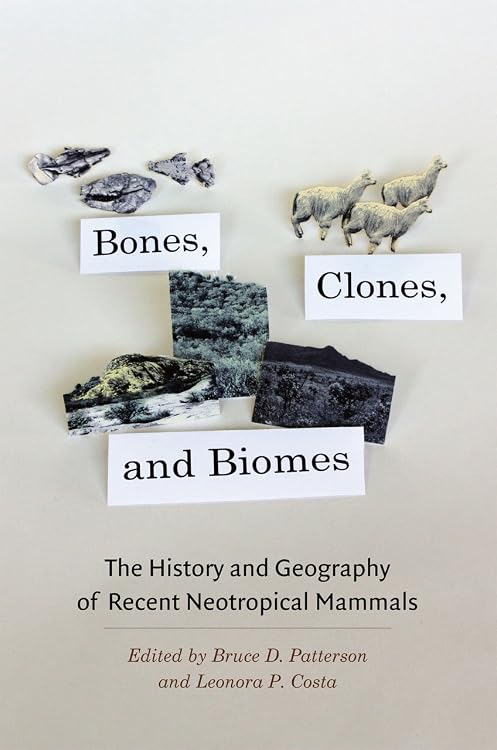
Bones, Clones, and Biomes: Neotropical Mammals
Bones, Clones, and Biomes is an illustrated scholarly book exploring the history and geography of recent Neotropical mammals. Its interdisciplinary scope connects mammal relationships and distributions with geology, paleobiology, systematics, and biogeography over the last 100 million years.
At a glance
- Explores modern mammal fauna across Central and South America in a long geological and biogeographic context.
- Covers lineages and landscapes across the last 100 million years.
- Brings together geology, paleobiology, systematics, mammalogy, and biogeography.
- The listing describes the book as relevant to conservation and management programs.
Reference price: $100.00
Price checked: Nov 23, 2026
View offerBlack Friday weekExplore the selectionPros and cons
Pros
- Offers an interdisciplinary perspective rather than focusing only on taxonomy or documenting species and distributions.
- Its extensive 432-page coverage may suit readers seeking geological context for Neotropical mammal diversity.
Technical specifications
9 specifications| Publisher | University of Chicago Press |
|---|---|
| Publication date | June 5, 2012 |
| Edition | Illustrated |
| Language | English |
| Print length | 432 pages |
| ISBN-10 | 0226649199 |
| ISBN-13 | 978-0226649191 |
| Dimensions | 6 x 1.3 x 9 inches |
|---|---|
| Weight listed | 1.55 pounds |
Who is it for?
A good fit for
- Readers studying Neotropical mammalogy, paleobiology, systematics, or biogeography.
- Researchers and students interested in how geological history shaped mammal distributions in Central and South America.
- Readers looking for background relevant to conservation paleobiology.
Less suited to
- Readers seeking a brief field guide, species-by-species identification reference, or a book focused only on current distributions.
Customer reviews on Amazon
- 5 stars
56% 56% - 4 stars
0% 0% - 3 stars
16% 16% - 2 stars
28% 28% - 1 star
0% 0%
The supplied aggregate ratings are limited in number and mixed, with ratings spanning five-star, three-star, and two-star categories. They do not reveal why readers rated the book that way, so they offer little basis for judging its scholarly usefulness. Its stated interdisciplinary scope and substantial page count are the clearer guide for readers deciding whether its subject matter fits their needs.
Frequently asked questions
What is this book about?
It explores the history and geography behind modern Neotropical mammal fauna, connecting mammal lineages and distributions with geological and biogeographic change.
What geographic areas does it cover?
The description identifies both Central and South America.
Is this mainly a species identification guide?
No. The listing presents it as a study of patterns, relationships, and long-term context, rather than a catalog of mammal diversity or distributions.
How long is the book?
The listing gives a print length of 432 pages.
Alternative options
Amniote Paleobiology: Perspectives on the Evolution of Mammals, Birds, and Reptiles
$56.00
The Emergence of Whales: Evolutionary Patterns in the Origin of Cetacea (Advances in Vertebrate Paleobiology, 1)
$227.65
The Evolution of Artiodactyls
$137.95
Evolution of Tertiary Mammals of North America: Volume 1, Terrestrial Carnivores, Ungulates, and Ungulate like Mammals
$133.00
Terrestrial Ecosystems Through Time: Evolutionary Paleoecology of Terrestrial Plants and Animals
$70.49
Avian Evolution: The Fossil Record of Birds and its Paleobiological Significance (TOPA Topics in Paleobiology)
$100.95