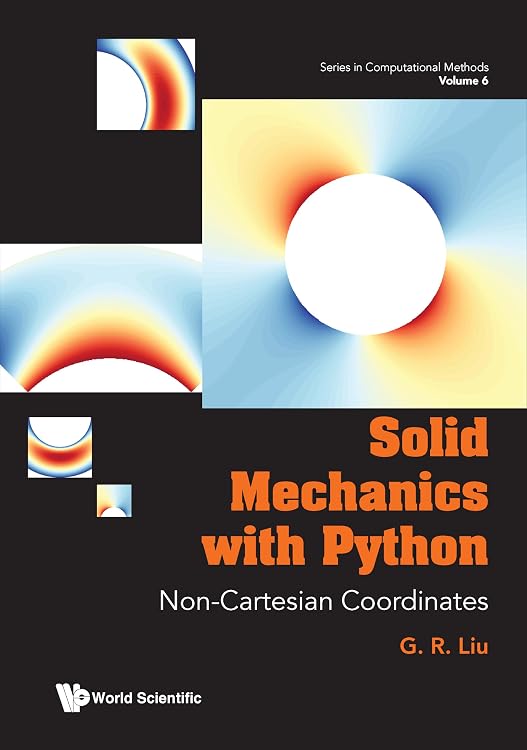
Solid Mechanics with Python: Non-Cartesian Coordinates
Solid Mechanics with Python: Non-Cartesian Coordinates covers solid mechanics in polar, cylindrical, and spherical coordinate systems, with Python-based symbolic and numerical problem solving. Its Jupyter notebook format brings theory, code, and worked examples together for study and practice.
At a glance
- Covers the mechanical behavior of solids in two and three dimensions under different loads.
- Introduces stress and displacement methods for solving solid mechanics problems.
- Uses Python for symbolic and numerical solutions, formulation derivation, and plotting.
- Jupyter notebook format combines theory, executable code, and formulation.
Reference price: $148.00
Price checked: Nov 24, 2026
View offerBlack Friday weekExplore the selectionPros and cons
Pros
- Connects continuum mechanics concepts with practical Python-based problem solving.
- Includes worked examples and illustrations across non-Cartesian coordinate systems.
- Notebook presentation is designed to support both reading and practice.
Technical specifications
8 specifications| Publisher | World Scientific Publishing |
|---|---|
| Publication date | July 24, 2026 |
| Language | English |
| Print length | 416 pages |
| ISBN-10 | 9819827019 |
| ISBN-13 | 978-9819827015 |
| Weight listed | 2.32 pounds |
|---|---|
| Dimensions | 6 x 0.77 x 9 inches |
Who is it for?
A good fit for
- Students learning solid mechanics with polar, cylindrical, or spherical coordinates.
- Readers seeking computational examples using Python and Jupyter notebooks.
- Engineers or researchers wanting a reference on stress and displacement solution methods.
Less suited to
- Readers seeking a general introductory Python programming book.
- Buyers who need a text focused only on Cartesian-coordinate formulations.
Frequently asked questions
What topics does this book cover?
It covers solid mechanics in two and three dimensions, focusing on polar, cylindrical, and spherical coordinate systems and the behavior of solids under different loads.
How is Python used in the book?
The listing describes Python applications for deriving formulations, solving problems symbolically or numerically, and plotting results.
Does the book use Jupyter notebooks?
Yes. It is described as being written in Jupyter notebook format, combining theory, code execution, and formulation.
Which solution approaches are introduced?
The book introduces the stress method and the displacement method.