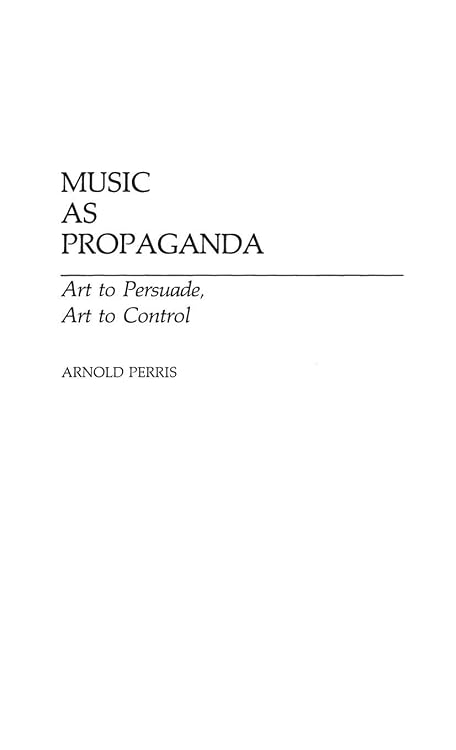
Music as Propaganda: Art to Persuade, Art to Control
Music as Propaganda: Art to Persuade, Art to Control examines music’s role in political and social change, from state-sponsored compositions to protest movements and religious practice. Its scope spans classical works, opera, Broadway, and rock, so it suits readers interested in music as a cultural and political force rather than a practical music guide.
At a glance
- Discusses music as a means of political and social change, including overt and disguised persuasion.
- Examples range from Broadway and familiar classical works to music associated with totalitarian regimes and 1960s protest movements.
- Considers composers including Shostakovich, Henze, Penderecki, and Bob Dylan, alongside nationalist opera and religious music.
Reference price: $100.00
Price checked: Nov 23, 2026
View offerBlack Friday weekExplore the selectionPros and cons
Pros
- Connects political history with a broad range of musical settings, from concert halls and Broadway to protest movements.
- The listed 247-page length gives readers a defined scope for this historical and cultural study.
Technical specifications
8 specifications| Publisher | Praeger |
|---|---|
| Publication date | December 11, 1985 |
| Language | English |
| Print length | 247 pages |
| ISBN-10 | 0313245053 |
| ISBN-13 | 978-0313245053 |
| Weight listed | 14.4 ounces |
|---|---|
| Dimensions | 5.5 x 0.62 x 8.5 inches |
Who is it for?
A good fit for
- Readers studying music, propaganda, political culture, or social movements.
- Readers interested in comparisons between Western and Eastern religious uses of music.
Less suited to
- Readers seeking a current survey, practical music instruction, or a narrowly focused study of one composer or genre.
Customer reviews on Amazon
- 5 stars
100% 100% - 4 stars
0% 0% - 3 stars
0% 0% - 2 stars
0% 0% - 1 star
0% 0%
The supplied rating evidence consists of a single five-star rating, too little to establish a reliable pattern of reader experience or explain what the reader valued. Consider the book's stated historical and cultural focus, and its 247-page length, as the more useful basis for judging fit.
Frequently asked questions
What is this book about?
It examines how music has been used to influence political and social change, with examples from state compositions, popular music, protest, opera, and religious services.
Which musicians and musical settings are discussed?
The listing mentions Shostakovich, Henze, Penderecki, Bob Dylan, nationalist opera, Broadway, concert halls, and rock and roll bands.
Is this a practical guide to music?
No practical instruction is described. The listed focus is historical and cultural, examining music's persuasive and political roles.
Alternative options

100 Incredible Facts About Classical Music: A Simple and Curiosity-Filled Guide to Composers, Operas, and Timeless Masterpieces (100 Amazing Facts: Masterminds of Classical Music)
$12.99
COMMUNING WITH MUSIC: Practicing the Art of Conscious Listening
$15.95
The Inner Nature of Music: And the Experience of Tone (CW 283) (The Collected Works of Rudolf Steiner) (Volume 283)
$24.47
The Spring of Sounds: All About Classical Music
$9.99
The Greatest Composers of All Time: Lives, Music, and the Quest to Capture Human Experience (The Greatest of All Time)
$7.50
Russia’s New Imperialism: Capital and Ideology
$25.49
Propaganda
$5.80

The Society of the Screen: Vilém Flusser’s Radical Prescience
$27.68

In Tune With The World
$12.00
Madness and Civilization: A History of Insanity in the Age of Reason
$11.48
Myth of the Machine : Technics and Human Development
$16.49