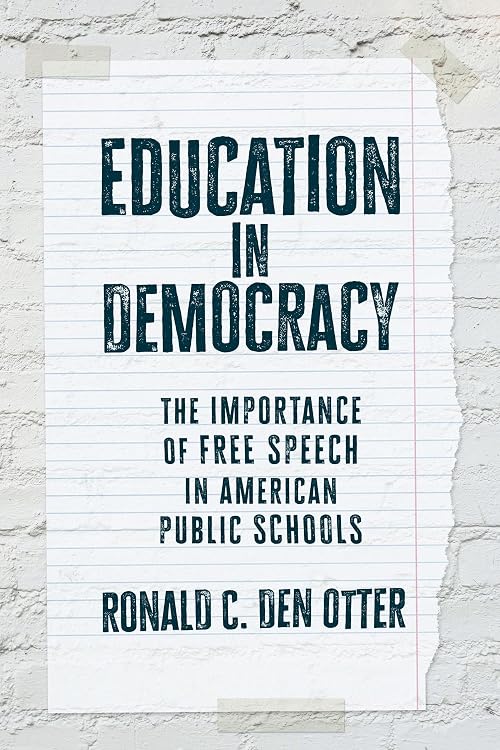
Education in Democracy: The Importance of Free Speech in American Public Schools
Importance: Education in Democracy examines student free-speech rights in American public junior high and high schools. Ronald C. Den Otter argues for treating secondary students more like public university students and proposes a stricter version of the Tinker substantial disruption test.
At a glance
- Focuses on free-speech rights of junior high and high school students in American public schools.
- Discusses Supreme Court jurisprudence and argues for a stricter version of the Tinker substantial disruption test.
- Frames public schools as places for developing student autonomy, tolerance, and democratic participation.
Reference price: $99.99
Price checked: Nov 16, 2026
View offerBlack Friday weekExplore the selectionPros and cons
Pros
- Addresses secondary-school student speech, a topic the listing says is often overlooked in debates focused on college campuses.
- Connects constitutional doctrine with questions of student autonomy and civic learning.
Technical specifications
8 specifications| Publisher | University Press of Kansas |
|---|---|
| Publication date | May 26, 2026 |
| Language | English |
| Print length | 296 pages |
| ISBN-10 | 0700641467 |
| ISBN-13 | 978-0700641468 |
| Weight listed | 1.32 pounds |
|---|---|
| Dimensions | 5 x 0.37 x 8 inches |
What to know before buying
Listing details to confirm
The listing describes the author's argument and proposed legal approach. It does not establish that the proposal is current law or a settled judicial standard.
Who is it for?
A good fit for
- Readers interested in student free-speech rights, education law, or constitutional law.
- Teachers, school leaders, and policy readers considering student autonomy and civic education.
Less suited to
- Readers seeking a neutral survey of all positions rather than a book presenting a case for expanding student speech rights.
Frequently asked questions
What subject does Education in Democracy cover?
It addresses free-speech rights for junior high and high school students in American public schools, including relevant Supreme Court jurisprudence.
What legal approach does the author propose?
The listing says Den Otter argues for a stricter version of the Tinker substantial disruption test and for treating public secondary students like public university students.
Is the book a neutral overview of the debate?
The listing presents it as an argument for respecting student autonomy and expanding student speech rights, rather than describing it as a neutral survey.